About Reading Śrī Bhuvaneśvarī Devi Temple
Śrī Bhuvaneśvarī Devi
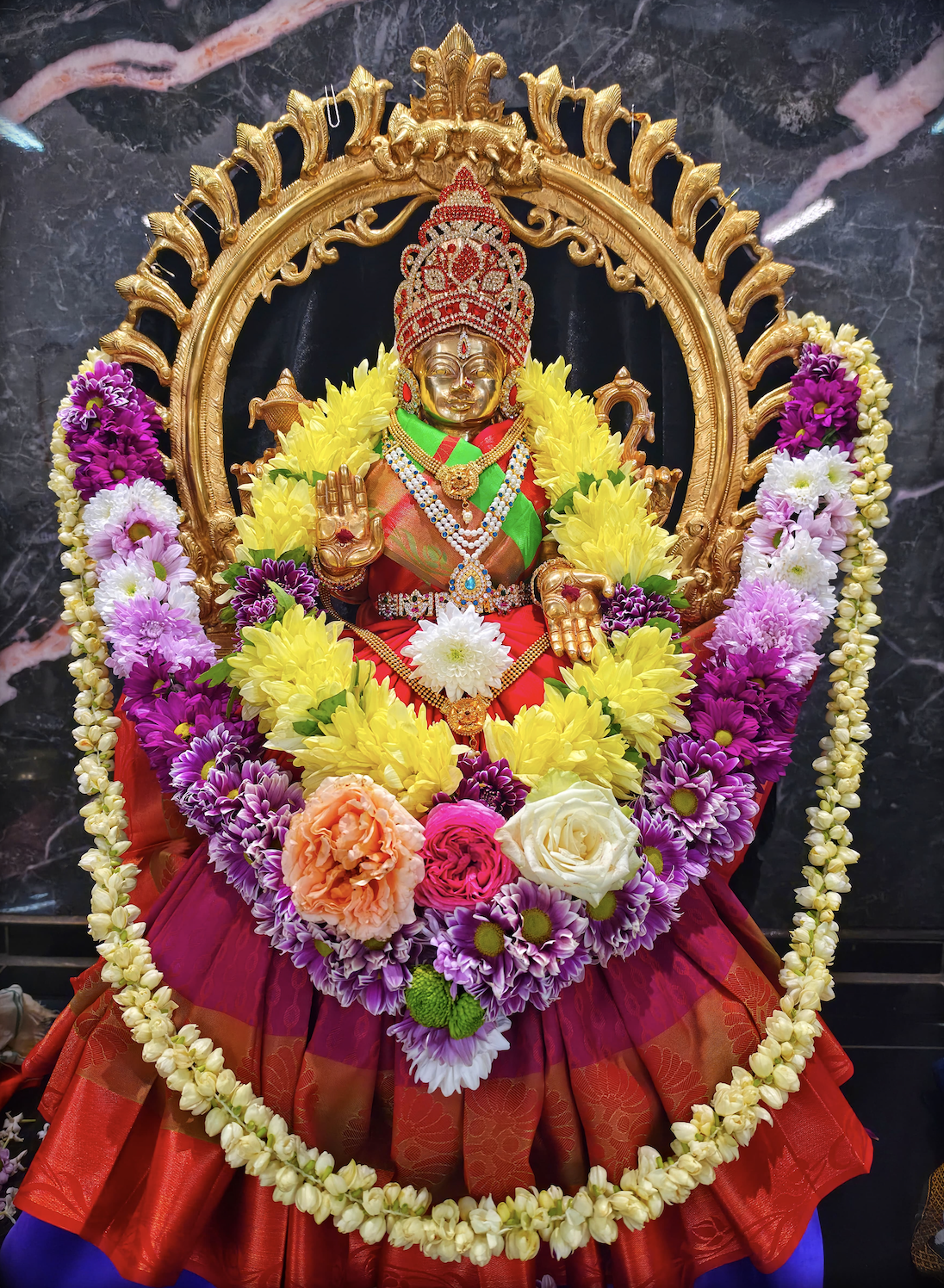
Goddess Śrī Bhuvaneśvarī Devi is one of the ten Mahāvidyās (Great Wisdom Goddesses) in Shaktism, a major tradition within Hinduism. Her name is a compound of Bhuvana (the worlds or the universe) and Īśvarī (Queen or Mistress), signifying that she is the "Queen of the Universe" — the Goddess of all the Worlds.
She is regarded as a supreme aspect of the Divine Mother (Mahādevī) and is often identified as the form of Ādi Parāśakti — the primal, creative energy of the cosmos.
Key Attributes and Symbolism
Goddess of Space
While Goddess Kālī represents Time (Kāla), Bhuvaneśvarī represents Space — the matrix in which all existence is created, sustained, and dissolved. She is the power that provides the "room" for the universe to exist.
Iconography
Appearance
Radiant golden complexion reminiscent of the rising sun; three eyes representing knowledge of past, present, and future; a gentle, compassionate face with a smiling demeanour.
Four Arms
Noose (Pāśa): Represents the power to bind and draw devotees toward her, and to trap the illusions of the material world.
Goad (Aṅkuśa): Symbolises the power to discipline, guide, and direct the mind and spirit on the path of righteousness.
Abhaya Mudrā: The gesture of fearlessness, offering protection and refuge to her devotees.
Varada Mudrā: The gesture of conferring boons, symbolising her grace and boundless generosity.
Adornments
Crowned with a crescent moon, symbolising the cycles of creation. Seated upon a lotus, representing purity and detachment from the material world.
Motherhood
The nurturing cosmic mother who provides the "milk of existence" to all beings across the three worlds — Bhūḥ, Bhuvaḥ, Svaḥ.
Philosophical and Spiritual Significance
Creation and Preservation
Bhuvaneśvarī embodies the creative principle. She is the power that enables the gods — Brahmā, Viṣṇu, and Śiva — to perform their respective functions of creation, preservation, and dissolution.
Overcoming Illusion (Māyā)
Her bīja (seed) mantra is Hrīṁ, deeply connected to the concept of Māyā (illusion). Through devotion to her, a seeker can pierce through the veil of worldly illusion to realise the underlying divine reality.
Cosmic Vision
Devotees worship her to gain "cosmic vision" — the ability to see beyond narrow, ego-driven perspectives and understand the interconnectedness of all existence. She is invoked for harmony, abundance, and the manifestation of divine will.
Role in the Mahāvidyās
As the fourth Mahāvidyā, she represents the transition from the absolute, formless Divine to the manifested, physical world. Unlike some Mahāvidyās who carry fierce or terrifying forms, Bhuvaneśvarī is celebrated for her beauty and benevolence.
She reminds practitioners that the material world is not to be discarded or shunned, but is a Līlā (divine play) of the Goddess herself — and that the cosmos is a manifestation of her own being.
Jagadguru Ādi Shankaracharya
c. 788 – 820 CE
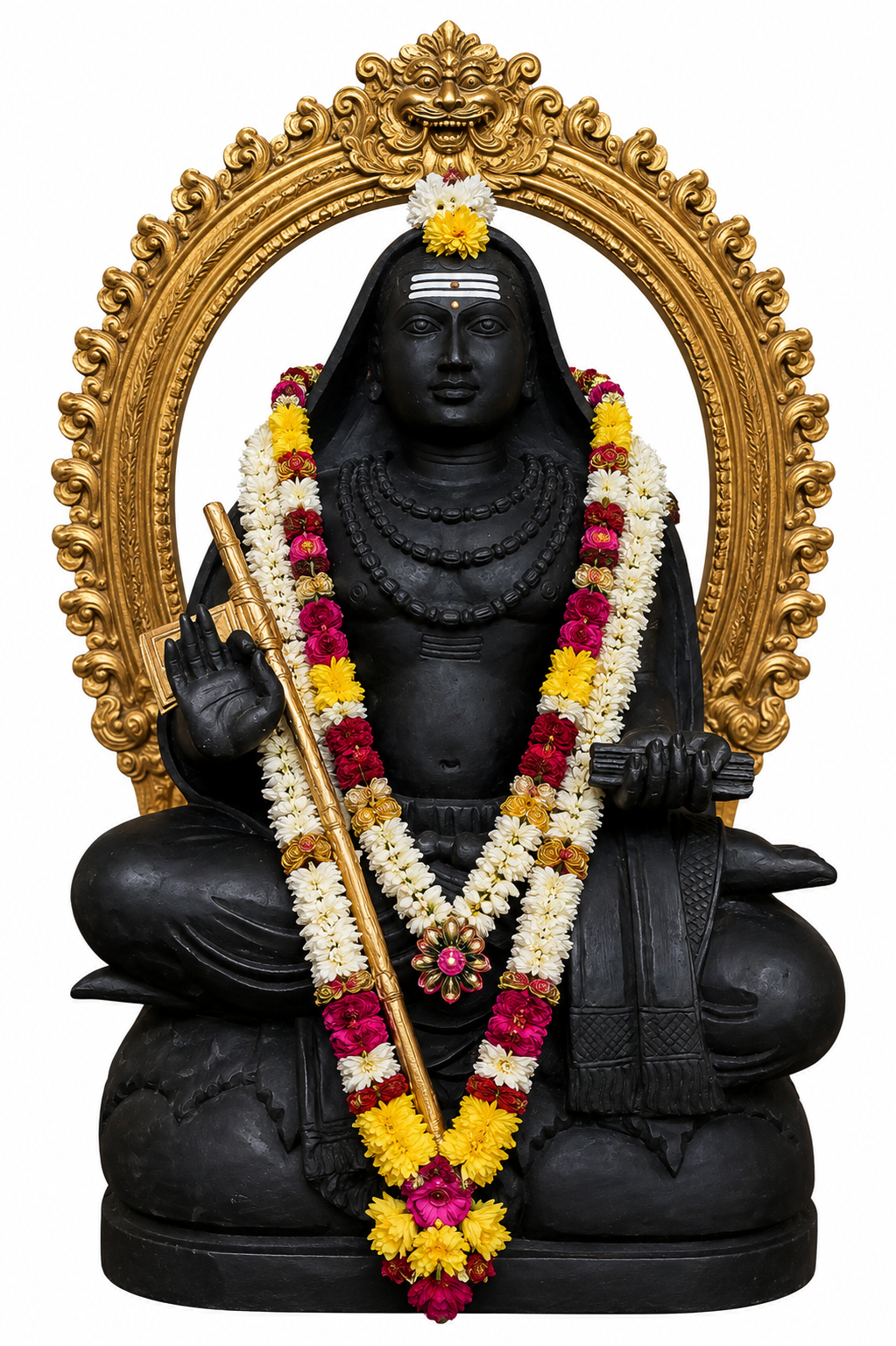
Jagadguru Ādi Shankaracharya (c. 788–820 CE) is one of the most influential philosophers and theologians in Indian history. He is the primary consolidator of Advaita Vedānta — the non-dualistic school of Hindu philosophy which asserts that the individual self (Ātman) and the ultimate reality (Brahman) are one and the same.
The title "Jagadguru" means "Teacher of the World," reflecting his profound impact on the revival and organisation of Vedic thought across the Indian subcontinent.
"Brahma Satyam Jagan Mithyā, Jīvo Brahmaiva Nāparaḥ"
Brahman alone is real; the world is an appearance; the individual self is not different from Brahman.
Core Philosophy: Advaita Vedānta
Non-Dualism
Shankaracharya's core teaching asserts that Brahman is the only truth, the world is illusory in a relative sense, and the individual self is not different from Brahman. All apparent multiplicity is an expression of the one undivided reality.
Knowledge and Liberation
He emphasised Jñāna Mārga (the path of knowledge) as the primary means to attain Mokṣa (liberation). Ignorance (Avidyā) causes the soul to perceive separation from the Divine — only through realisation of one's true nature can this be removed.
Commentaries (Bhāṣyas)
His commentaries on the Prasthānatrayī reconciled seemingly contradictory Vedic texts into a cohesive non-dualistic framework:
The Upaniṣads — foundational texts of Vedānta philosophy
The Bhagavad Gītā — the divine discourse of Lord Kṛṣṇa
The Brahma Sūtras — a systematic summary of Vedāntic thought
Contributions and Legacy
Revival of Sanātana Dharma
Through extensive travel across India, engaging in philosophical debates (vāda) with scholars of other traditions, he re-established the authority of the Vedas and unified fragmented Hindu practice.
The Four Maṭhas
To ensure the continuity of his teachings, he established four monastic centres at the cardinal points of India:
North: Jyotirmaṭha, Badrinath
South: Śṛṅgeri Śāradā Pīṭha, Karnataka
East: Govardhana Pīṭha, Puri
West: Dvārakā Pīṭha, Gujarat
Integration of Bhakti and Jñāna
A prolific composer of devotional hymns, works such as Bhaja Govindam, Saundaryalaharī, and Nirvāṇa Ṣaṭkam show that the path of knowledge and the path of devotion are not mutually exclusive.
Śanmata — Six Paths
He organised the worship of the six major Hindu deities — Śiva, Viṣṇu, Devī, Gaṇeśa, Sūrya, and Skanda — into a unified system, promoting harmony among different sectarian traditions.
Shankaracharya is a bridge between ancient Vedic tradition and modern Hinduism — a symbol of intellectual clarity, spiritual discipline, and the pursuit of ultimate truth. His legacy endures in every Maṭha, every devotional hymn, and every heart that seeks the non-dual reality.
On the auspicious day of October 30, 2025, with profound compassion and divine grace, Sringeri Jagadguru Sri Sri Bharati Tirtha Mahasannidhanam performed a sacred Puja, breathing spiritual life and vibrations into the pavana Vigraham of Jagadguru Adi Shankaracharya. Witness the divine moments of this holy worship and partake in the Guru's blessings through this sacred video footage.
Charged with the intense tapas and blessings of Mahasannidhanam, this sacred Vigraham journeyed across the oceans to the UK to spread the timeless light of Shankaratatva.
By the boundless grace of the Guru, the grand Shankaracharya Vigraham Pratishthapana was sublimely performed at the Sri Bhuvanesvari Temple in Reading on December 4, 2025, sanctifying the region on the highly auspicious and holy occasion of Datta Jayanti.
A Sacred Home in Reading
The Śrī Bhuvaneśvarī Devi Temple in Reading was established by a devoted community of families in Reading, Berkshire, united by their shared love for Sanātana Dharma and a heartfelt aspiration to create a permanent sacred abode for Śrī Bhuvaneśvarī Devi in the United Kingdom.
What began as a small gathering of devotees has blossomed into a vibrant spiritual community—a home away from home for Hindus in Reading and the surrounding regions. As we reflected on the future of this sacred initiative, we were immensely fortunate and blessed to receive the guidance of Guruji Sri Avinash Ganesan, whose profound spiritual wisdom and dedicated Śrī Vidyā upāsanā helped shape the vision and direction of this humble abode of Śrī Bhuvaneśvarī Devi.
Sri Avinash Ganesan (Śrī Sahajānandhanātha) is the present Guru of the Sri Sathya Chandi Mandali lineage, a responsibility he assumed in 2012 under the direct instructions of his revered Guru, Gurumāta Sathyāmba. Since then, he has devoted himself to reviving and nurturing the sacred tradition of Śrī Vidyā across the world, carrying forward the flame of the lineage with unwavering dedication. Through his teachings, community-building efforts, and spiritual initiatives, the Mandali continues to flourish as a vibrant centre for Śrī Vidyā upāsanā.
Today, the Reading temple hosts regular pūjās, festivals, satsangs, and cultural activities, welcoming all who seek the blessings of the Divine Mother and a deeper connection with their spiritual heritage.
Guided by the timeless values of Bhakti (devotion), Dharma (righteous living), Seva (selfless service), and Community, the temple serves not only as a place of worship but also as a centre for learning, culture, and community care, open to devotees and well-wishers from all backgrounds.
Temple Activities
From daily worship to community service — how we live our faith throughout the year.
Daily Pujas & Archanas
Morning and evening worship offered to Śrī Bhuvaneśvarī Devi, including abhisheka, archana, and deeparadhana.
Festival Celebrations
Navaratri, Diwali, Ugadi, Vaikunta Ekadashi, and other Hindu festivals celebrated with grandeur and devotion.
Bhajan & Satsang
Devotional singing and spiritual discourses that bring the community together in the joy of collective worship.
Vedic Education
Teaching Sanskrit, scriptures, and Vedic traditions to devotees of all ages — keeping our spiritual heritage alive.
Annadanam
The sacred offering of food to all who come — honouring the tradition that serving the hungry is serving the divine.
Youth Programmes
Engaging young devotees through spiritual classes, cultural activities, and leadership opportunities rooted in dharma.
Cultural Programmes
Celebrating Indian classical arts, music, and dance that honour our civilisational heritage and inspire future generations.
Community Welfare
Supporting families in need, fostering social cohesion, and ensuring no one in our community feels alone.
Guru Parampara
Honouring the sacred teacher-disciple lineage that has preserved the wisdom of Sanātana Dharma across millennia.
Come Seek Her Blessings
Whether you are a lifelong devotee or visiting a temple for the first time — the doors of Śrī Bhuvaneśvarī Devi Temple are open to you.